Why tankless problems feel different.
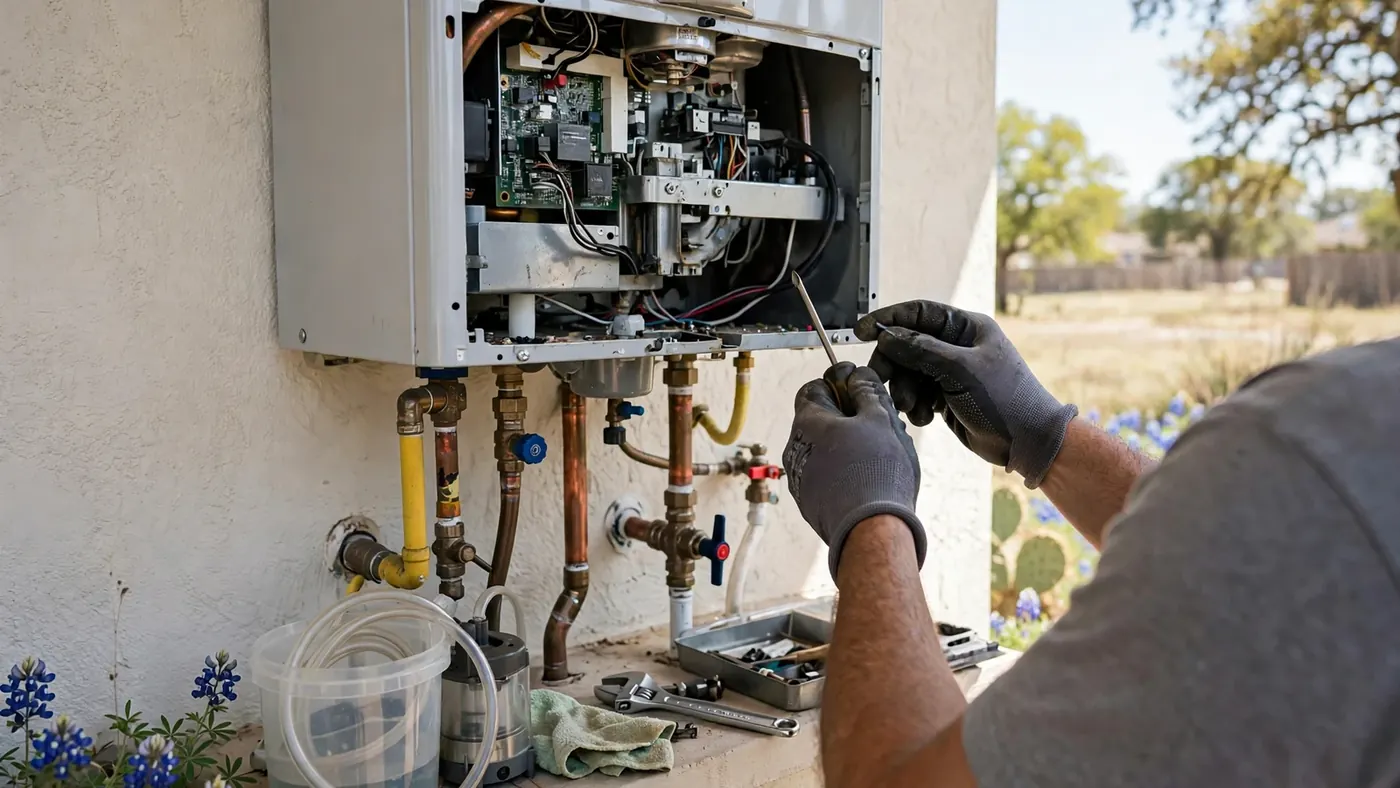
A tank heater fails slowly. A tankless unit fails by showing a code, shutting off or giving you a burst of cold water in the middle of a shower. The unit has sensors for flow, temperature, flame and exhaust, and any of them can stop the burner. That is a safety feature. It also means a small problem, like a dirty screen, can look like a big one.
Start with what you notice, then match it to a cause below.
Common symptoms and what they usually mean.
| Symptom. | Likely cause. | First step. |
|---|---|---|
| Error code and no hot water. | Blocked vent, flame sensor, or gas supply. | Check the code in the manual and the gas valve. |
| Cold water sandwich. | Short draws or scale in the heat exchanger. | Run water longer and plan a flush. |
| Water never gets hot enough. | Flow too high or scale. | Reduce flow and flush the unit. |
| Weak hot water flow. | Clogged inlet screen or scale. | Clean the filter screen. |
| Unit clicks but does not light. | Gas or igniter issue. | Confirm gas is on and call if it persists. |
Most manufacturers publish their codes. Look for the code in the manual, or photograph the display and send it to us.
Error code on the display or only lukewarm water? Call and read us the code, and we will tell you what it means.
Call (385) 488-1892.Hard water is the main enemy.
According to Spanish Fork City, total hardness runs 231 to 349 mg/L, which is 13.4 to 20.24 grains per gallon. In a tankless unit, hardness minerals bake onto the narrow passages of the heat exchanger. The result is less flow, higher temperature at the sensor and eventually an error code or a unit that cycles on and off.
The fix is a descaling flush, which we cover in our tankless service page. In water this hard, plan on one every year, and consider a softener upstream.
Venting, gas and installation problems.
A tankless unit draws a lot of gas for a short time. If the gas line is undersized, the unit may light at low flow and fail at high flow. Venting matters too. A blocked or leaking vent can trip the safety sensor, and in the worst case allow exhaust into the house.
If a unit was installed without a gas line check, or the vent run is longer than the manufacturer allows, the symptoms can look like a failed part. A plumber should check gas size and vent length before replacing anything.
Gas smell.
If you smell gas near the unit, leave the house, do not use switches and call the gas utility from outside. Then call us.
What you can safely check yourself.
These are low-risk checks that do not need tools.
- Clean the inlet water filter screen if the manual shows it.
- Make sure the gas valve and the water valves are fully open.
- Check the vent termination outside for nests, snow or debris.
- Try a lower flow at the faucet to see if the unit holds temperature.
- Write down the model, the error code and what you were doing when it happened.
Anything involving gas fittings, the burner or the vent joints should go to a plumber. A wrong guess can make the unit unsafe.
How a flush works.
Shut off power and gas.
Turn off the unit and the gas supply so it cannot fire during the flush.
.Close the isolation valves.
Turn the hot and cold isolation valves so water stops entering the unit.
.Connect the pump and bucket.
Attach hoses to the service ports and run descaling solution through the heat exchanger for the time the manufacturer lists.
.Rinse and restore.
Flush with clean water, clean the inlet screen, reopen the valves and check for leaks.
.
If your unit has no isolation valves, a plumber can add them. They are the single most useful upgrade for a tankless heater in hard water, since they make a yearly flush a short job.
Questions to ask before you buy or convert.
If you are thinking about a tankless unit, ask these before you sign anything.
- What gas line size does the unit need at full fire.
- What is the maximum vent run and does it fit.
- Are isolation valves included.
- Where will the condensate drain on a condensing model.
- What does the warranty say about hard water and maintenance.
Repair, flush or replace.
Age and use shape the decision. A unit under a decade old with a clean flush and a failed sensor is worth repairing. A unit that has never been descaled in this water and now shows repeat codes may have lasting damage, and the honest answer can be replacement. We say so on the visit, and we show you the flush water so you can see what came out.
A flush and a screen cleaning fix many units. A failed sensor or igniter is a repair. A cracked or badly scaled heat exchanger may cost as much as a new unit, and age decides it. We tell you the repair and replacement numbers side by side. If you decide to switch, our replacement page explains the process.
What Spanish Fork homes add to the picture.
Spanish Fork City says a permit is required for plumbing work, which includes converting a tank heater to tankless. The building office at 801-804-4540 can answer questions. The city also publishes the 231 to 349 mg/L hardness range, which is why we put isolation valves on every tankless install here.
If your home is in Springville, our Springville page. lists its water division number for questions about local water quality. If you live farther south, our service areas page covers Salem and Payson too.
Tankless questions from Spanish Fork homeowners.
A short pause between uses, scale in the heat exchanger or a flow that is too low for the unit can all cause it. A flush often helps.
In very hard water, once a year is a safe starting point. Spanish Fork City reports 231 to 349 mg/L, so we suggest that schedule.
You can clean the inlet screen and, with isolation valves, run a flush with the right solution. Gas and burner work belongs to a plumber.
Yes, because it removes the minerals that form scale. We still recommend an annual flush in hard water.
Yes. Call (385) 488-1892 at any hour. Have the model and error code ready.