How grease plugs a line.
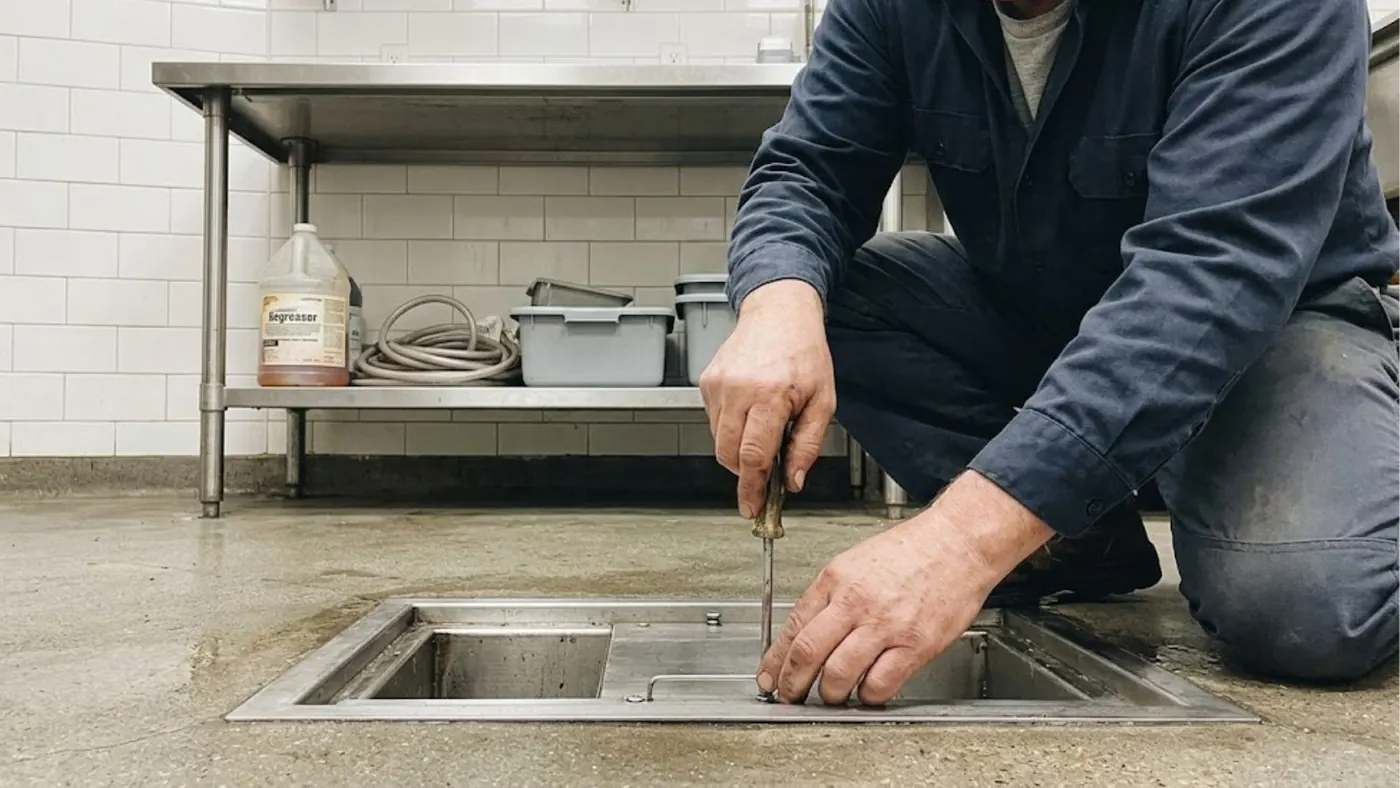
Hot grease flows easily. As it travels down the drain it cools, thickens and sticks to the pipe wall. Over weeks, the layer grows until only a narrow channel remains. Soap and food solids add to it. Then one busy night, a bit of rice or a bit of pasta closes the channel and the line backs up.
The plug is not in one place. The coating runs for many feet, and cabling a hole through it only buys time. That is why kitchens often call again within weeks.
Grease traps and interceptors.
A grease trap or interceptor sits in the line and catches fat before it enters the building drain. It works only if it is pumped on schedule. A trap that is full passes grease downstream, and the line downstream is the one that plugs. Keep a log with the date of each pumping, the volume and the hauler.
Most traps need service every few weeks to every few months, depending on volume and the type of kitchen. The right interval is the one your inspector, hauler and equipment maker agree on, not a guess.
Check the rule for your building.
Ask your landlord, the city and your hauler who is responsible for the trap and how often it must be serviced. Keep written records, since inspectors may ask for them.
Floor drain backing up in the middle of service? Call the 24/7 line and tell us if a grease trap is involved.
Call (385) 488-1892.Where kitchen lines plug.
| Location. | Typical cause. | Fix. |
|---|---|---|
| Prep sink or three compartment sink. | Food scraps, grease, soap film. | Cable then strainers and a habit change. |
| Floor drain near the line. | Mop water carrying grease and solids. | Jetting, then a floor drain screen. |
| Line downstream of the trap. | Grease that passed a full trap. | Pump the trap, then jet the line. |
| Building main. | Accumulated coating plus roots. | Camera, jetting and possibly repair. |
Daily habits that prevent backups.
These habits cost almost nothing.
- Scrape plates and pans into the trash before washing.
- Use strainers in every sink and floor drain.
- Wipe pans with paper towels before they go in the sink.
- Collect used oil in a container for pickup.
- Do not pour hot grease into floor drains.
- Train every new hire in the first week.
According to Spanish Fork City, residents should never put fats, oils and grease down the sink, disposal or toilet, and it warns that starchy foods like pasta and potatoes turn into paste when they mix with water. A restaurant sees those at volume, so a kitchen needs a stricter version.
What a camera shows in a kitchen line.
A camera shows how thick the coating is, how far it runs and whether the pipe has low spots that hold water and fat. Many kitchen lines have a belly where the pipe sags and grease collects. A belly will refill after every jetting, and the real fix is a repair, not a shorter schedule. The recording also gives your hauler and your landlord a shared picture of the problem.
A cleaning schedule that works.
Start with a camera look at the line to learn where grease collects. Then match jetting to what the camera shows. A busy kitchen may need jetting every few months, a light-use cafe once or twice a year. Pair it with trap pumping and write the dates in a log. If a line backs up between visits, shorten the interval.
Our commercial plumbing page explains how we run recurring service and what we leave in writing for your landlord and inspector.
Landlords, tenants and lease language.
In a shared building, the grease line may serve several tenants, and a blockage in one tenant space can back up another. Read the lease for who pays for trap service and line cleaning. If the problem is in the building main, a camera pass shows where it sits and helps assign responsibility. We document the findings in writing so you can pass them to the landlord.
New tenants should ask for the trap service log before they sign. A trap that has not been pumped in a year is a cost you inherit on the first busy weekend.
If you are opening a new kitchen, plan drains and a trap before the floor is poured. Adding a trap later means cutting concrete, and local rules may require one from the start. Check with the building office before you finalize the layout, and keep the drawings with your records.
What to do when it backs up mid-shift.
Stop the water.
Stop dishwashing and prep sink use so the backup does not grow.
.Protect the floor.
Block off the area, put down absorbent material and protect food and equipment.
.Call the 24/7 line.
Tell us the building type, the fixtures affected and whether a trap is involved.
.Keep records.
Photograph the backup and note the time, for your landlord and insurer.
.
If sewage reaches food areas, you may have to close until the area is cleaned. Check with the health department on reopening rules.
Food service along Main Street and the Parkway.
Spanish Fork has food service along the Main Street and Spanish Fork Parkway corridors, and every one of those businesses sends grease through the same kind of building drain. The city asks residents to keep fats, oils and grease out of drains, and it says owners clear their entire service line. A grease backup in your lateral is the owner side.
Spanish Fork City says a permit is required for plumbing work, and the building office at 801-804-4540 can answer questions about changes to a kitchen line. We serve restaurants in Springville too. See our Springville page.. Our areas page shows which nearby towns share this dispatch.
Kitchen line questions from Spanish Fork businesses.
It depends on volume and trap size. Many are serviced every few weeks to every few months. Follow your hauler and local rules.
Usually yes, because it scours the coating. A camera first confirms the pipe can take the pressure.
It depends on the lease. Spanish Fork City says owners clear their service line. Ask your landlord and keep records.
Yes. Butter, oil, dough and cleaning water all build coatings in a line.
Yes. Call (385) 488-1892 any hour.