Safety first: power off before you touch it.
Turn off the disposal switch and unplug it, or switch off its breaker. Never put your hand in the chamber. A disposal can start with a hand inside if the switch is on. Use tongs or pliers to pull out anything you can see.
Once the power is off, you can safely work from the bottom of the unit and under the sink.
Humming and not spinning: free the flywheel.
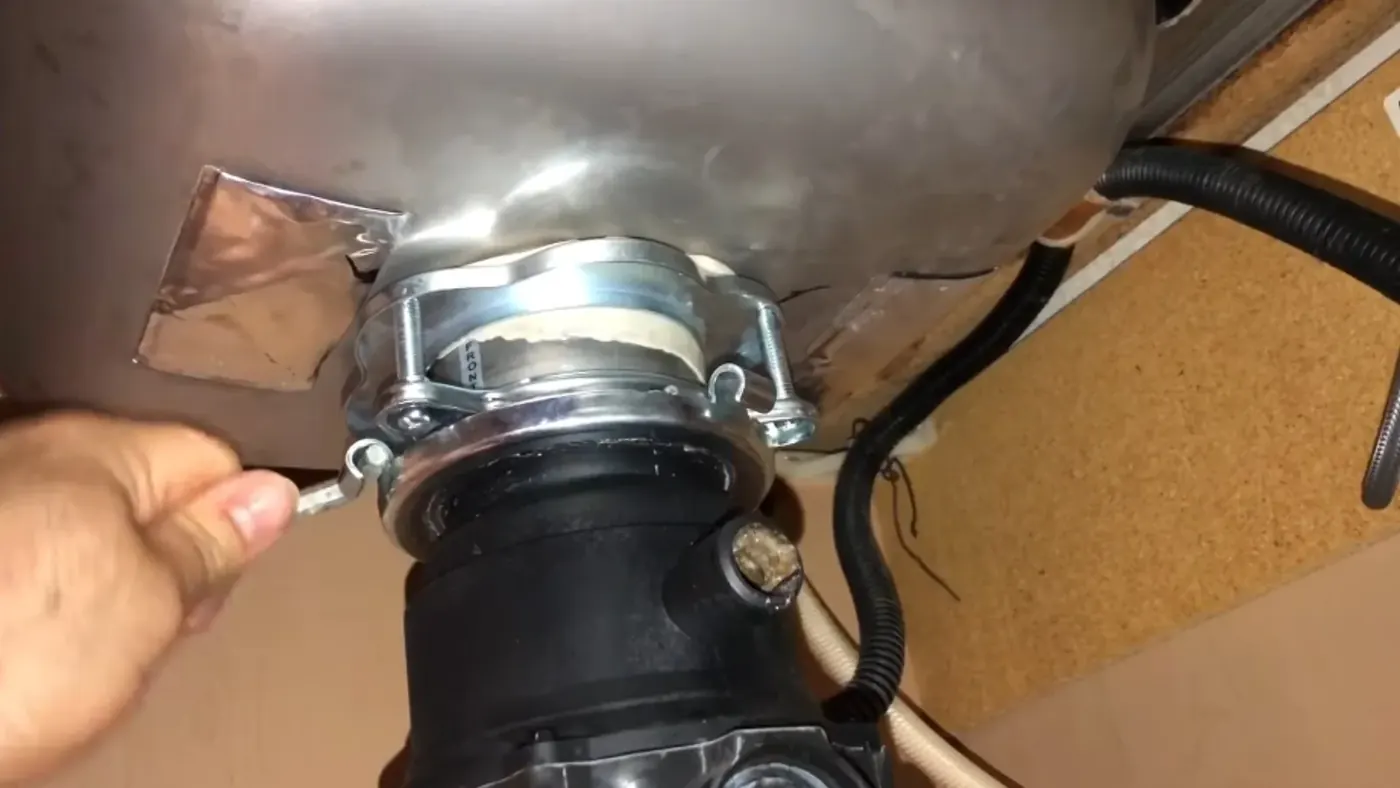
A hum with no spin means the flywheel is jammed. Look at the center of the underside of the unit for a hex socket, usually one quarter inch. Insert the hex key from your disposal kit or a standard Allen wrench and work it back and forth until the wrench turns freely. That frees the jam.
Remove the object that caused it, then press the red reset button on the bottom of the unit and test with water running. If it hums again, the motor may be failing.
Water leaking under the sink? Switch off the disposal, close the stops and call.
Call (385) 488-1892.Dead with no sound.
If nothing happens when you turn it on, try the reset button first. It trips when the motor overheats or jams. Then check the outlet, which on many kitchens is under the sink and controlled by a wall switch. A tripped GFCI or breaker is another common cause.
If the unit stays dead after reset, power and a working outlet, the motor or switch has failed. At that point replacement is usually better than repair.
Finding a leak.
| Where it leaks. | Cause. | Fix. |
|---|---|---|
| Top, around the sink flange. | Worn plumber putty or loose mounting. | Reseat the flange with new putty. |
| Side, where the dishwasher hose attaches. | Loose clamp or worn hose. | Tighten or replace the clamp. |
| Side, at the drain outlet. | Worn gasket or loose bolts. | Replace the gasket and tighten. |
| Bottom of the unit. | Cracked housing or failed seal. | Replace the disposal. |
Dry the area, run water and watch with a flashlight. Dye in the water helps find a tiny leak.
Smells and slow drains.
A smell is usually food on the walls and under the splash guard. Run cold water, grind ice and citrus peels, and scrub the splash guard with a brush. If the sink drains slowly after you grind, the clog is downstream of the disposal in the trap or branch line, and that is a drain cleaning call.
According to Spanish Fork City, residents should keep fats, oils and grease out of sinks and disposals, and it names starchy foods like pasta and potatoes, since they turn to paste when mixed with water. Those items are the usual cause of kitchen line trouble.
Repair or replace.
A jam that frees with the hex key and does not return is a repair. A unit that leaks from the body, trips repeatedly or is more than ten years old is better replaced. A new disposal is a simple swap with the same mounting, though some sinks need a new mounting kit and power requires a switch or outlet.
We replace disposals, and if the kitchen drain needs cleaning at the same visit, we do both. See our disposal page for what a visit includes.
Installing a new disposal.
Disconnect.
With the power off and unplugged, remove the drain trap and the dishwasher hose, then loosen the mounting ring.
.Remove the old unit.
Support the weight, lower the unit and keep the sink flange in place if it is sound.
.Mount the new unit.
Attach the mounting assembly, lift the disposal into place and lock the ring.
.Reconnect and test.
Reattach the drain and the dishwasher line, knock out the plug on the dishwasher inlet if needed, and run water to check for leaks.
.
The dishwasher inlet has a plastic plug that must be knocked out on a new disposal. If it stays in, the dishwasher will not drain. Many people forget this and think the new unit is leaking.
Sizing matters. A quarter horsepower unit works for light use, while a larger motor handles heavier use and tougher scraps. For a family that cooks often, a half horsepower or larger unit is a better fit and lasts longer.
When the motor itself is the problem.
A motor that hums and trips the reset button even after you free the flywheel has likely worn out. A smell of burning, a slow spin that stalls on soft food, or a sound like grinding metal are other signs.
Repairing a motor costs about what a new unit does, so replacement is the sensible choice. Check that the new unit fits your sink flange and the existing mounting. Ask whether the old mounting ring can be reused, and keep the box and the manual in a kitchen drawer for the warranty.
What to grind and what to skip.
Habits decide how long a disposal lasts. These rules prevent most jams.
- Cold water running before, during and after.
- Small scraps and soft food waste.
- No grease, oil or fat.
- No bones, corn husks, celery stalks or large fibrous scraps.
- No pasta, rice or potato peels in quantity, since they swell into paste.
- No coffee grounds in bulk.
Hard water inside the disposal.
Spanish Fork City publishes total hardness of 231 to 349 mg/L. Scale builds on the grinding plate and inside the chamber, which makes the unit work harder over time. A cold water flush after each use and an occasional vinegar and ice cycle keep scale in check.
Plumbing work in the city needs a permit, and the building office at 801-804-4540 can answer questions about larger kitchen changes. If you are in Springville, see our Springville page.. For the full list of towns we dispatch to, see our service areas page.
Disposal questions from Spanish Fork homeowners.
On the bottom of the unit, a small red button. Press it after the unit cools and after you free any jam.
No. Spanish Fork City asks residents to keep fats, oils and grease out of sinks and disposals, since they cool and harden in the line.
Food residue on the walls and splash guard. Clean it with ice and citrus peels and a brush.
Commonly around a decade, depending on use and water quality.
A jam or dead unit can be scheduled. If there is a leak that is reaching the cabinet floor, call (385) 488-1892 at any hour.